
Diamond Saw Blade End Runout and Radial Runout
author: Susan
2025-08-11
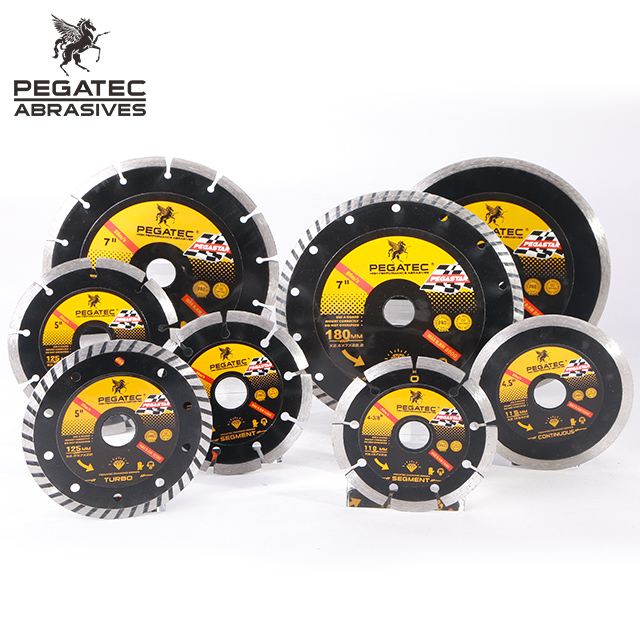
During the cutting process, a diamond saw blade experiences slight vibration in the rotating blade base. This vibration occurs both horizontally and vertically. Based on these differences, these two types of vibration are categorized as end runout and radial runout.
To better determine specific, comparable values, a horizontal turntable is used. The saw blade is placed horizontally on the turntable. The blade is then secured and the turntable is activated. As the turntable rotates slowly and evenly, two values, static end runout and static radial runout, can be recorded using a surveying instrument.
The runout of the saw blade's largest diameter point in the plane of the blade is called end runout. A dial indicator measures the left-right deviation. The saw blade base is typically tested, while the cutter head is not. This is primarily because unpredictable issues can arise during the cutter head welding process, potentially obscuring the blade's problem. Therefore, for better analysis, measuring the end runout of the base can both eliminate the problem of base end runout and directly measure a more accurate and uninterrupted end runout value. Therefore, if a saw blade experiences excessive end runout, it's most likely due to a problem with the cutter head.
The runout of the saw blade's largest diameter in the direction of the blade's diameter is called roundness, also known as radial runout. Simply put, during end runout, the saw blade's teeth develop an arc-shaped roundness at the vertical end. During the cutting process, the blade also creates this same cutting arc. Therefore, under normal circumstances, a large radial runout directly affects the cutter head's cutting efficiency.
The purpose of studying end runout and radial runout is primarily to mitigate various issues that may arise during the cutting process, such as blade deviation and distortion of the cutting pattern. However, static end runout and radial runout only reflect the performance of a diamond saw blade at low speeds and cutting intensity, and do not represent the blade's true cutting performance. Therefore, researchers have introduced two other parameters to more accurately reflect the performance of a saw blade during cutting.
Dynamic end runout refers to the vertical oscillation distance of the saw blade's point farthest from the center of the circle at high speed, essentially the distance from the end face. End runout is generally tested at the blade's recommended speed, with some manufacturers even testing at a specified extreme speed. The resulting end runout value is then used to determine the value.
Dynamic radial runout refers to the horizontal distance from the top and bottom of the arc formed by the saw blade's point farthest from the center of the circle at high speed. Simply put, this is the radial runout.
With these parameters, the quality of a saw blade's base can be clearly distinguished. Generally speaking, blades with less radial runout and less end runout have a more stable base structure and are therefore of higher quality.
Can brazed diamond blades replace diamond saw blades? - No, because brazed diamond only has a surface layer and wears out after cutting a few meters. Prolonged cutting cannot replace diamond blades, and they are more expensive.
How to Properly Use Cutting Discs & Common Issues
Matters needing attention in choosing diamond cutter head
Related Article

Cutting disc and grinding disc are two common cutting tools that are used in various industries. Although both of them are used for cutting, they have different performance and
Cutting Disc And Grinding Disc